
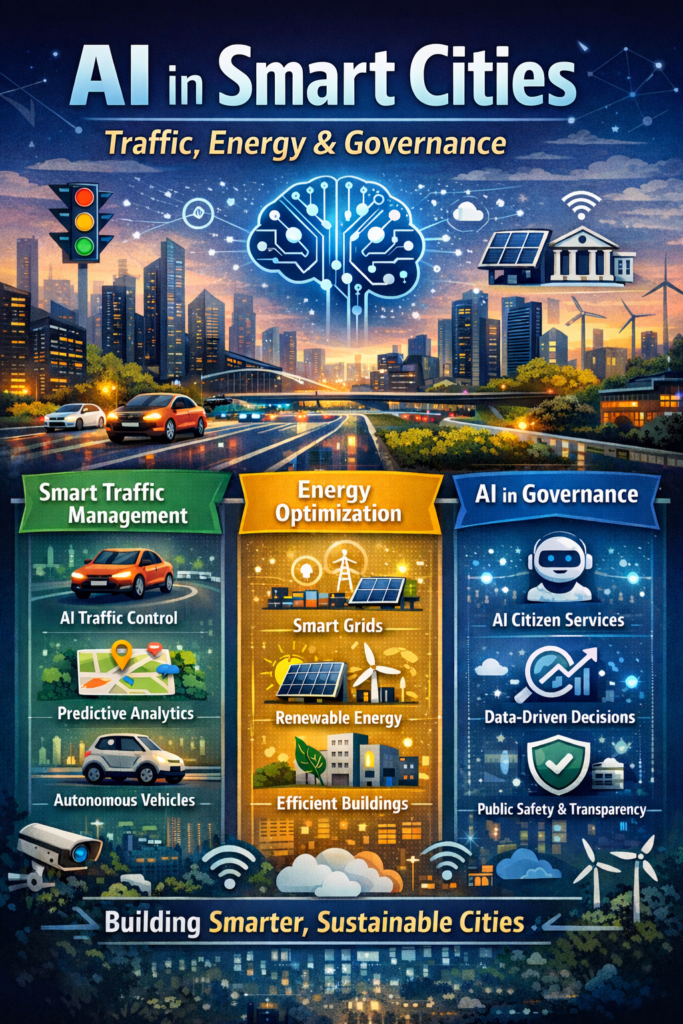
AI in Smart Cities: How Artificial Intelligence Is Revolutionizing Traffic, Energy, and Governance
Why Cities Need Artificial Intelligence Now
By 2050, nearly 70% of the world’s population will live in urban areas. While cities drive economic growth and innovation, they also face growing challenges—traffic congestion, energy shortages, pollution, climate change, inefficient governance, and strained public services. Traditional urban management systems are no longer sufficient to handle this complexity.
This is where Artificial Intelligence (AI) becomes a game-changer.
AI enables cities to transition from reactive governance to predictive, adaptive, and autonomous urban systems. When integrated with IoT, big data, cloud computing, and edge intelligence, AI becomes the digital brain of a smart city—capable of optimizing traffic, managing energy efficiently, and improving governance transparency.
This comprehensive guide explores how AI in smart cities is transforming traffic management, energy systems, and governance, along with benefits, real-world applications, challenges, and future trends.
What Is a Smart City? Understanding the AI Connection
A smart city uses digital technologies to enhance performance, reduce resource consumption, and improve the quality of life for citizens. AI plays a central role by converting raw urban data into actionable intelligence.
Core Technologies Behind Smart Cities
- Artificial Intelligence and Machine Learning
- Internet of Things (IoT)
- Big Data Analytics
- Cloud and Edge Computing
- Computer Vision
- Digital Twins
AI allows these systems to learn from data, adapt to changes, and make intelligent decisions in real time.
AI in Smart City Traffic Management
Traffic congestion costs billions in lost productivity, fuel wastage, and environmental damage. AI is redefining urban mobility by enabling intelligent, adaptive transportation systems.
1. Intelligent Traffic Signal Control
Traditional traffic lights operate on fixed timers. AI-based systems use:
- CCTV cameras
- Road sensors
- GPS data
- Vehicle-to-Infrastructure (V2I) communication
Machine learning algorithms analyze traffic density and dynamically adjust signal timings, reducing congestion and idle time.
Benefits:
- Faster traffic flow
- Reduced emissions
- Lower fuel consumption
2. Real-Time Traffic Monitoring Using Computer Vision
AI-powered computer vision systems detect:
- Traffic violations
- Accidents
- Illegal parking
- Pedestrian movement
This data enables immediate response from traffic authorities and improves road safety.
3. Predictive Traffic Analytics and Congestion Forecasting
AI models forecast traffic congestion using:
- Historical traffic data
- Weather conditions
- Public events
- Construction schedules
Cities can issue early warnings, suggest alternative routes, and optimize public transport scheduling.
4. AI in Public Transportation Systems
AI optimizes public transport by:
- Predicting passenger demand
- Adjusting bus and metro frequency
- Optimizing routes in real time
Smart ticketing and AI-based fare systems also improve commuter experience.
5. Autonomous and Connected Vehicles
Self-driving vehicles rely heavily on AI for:
- Object detection
- Path planning
- Collision avoidance
Connected vehicles communicate with traffic systems, reducing accidents and enabling smoother traffic flow.
AI in Smart Energy Management
Energy sustainability is critical for smart cities. AI-driven energy systems enable cities to reduce wastage, integrate renewables, and achieve climate goals.
1. AI-Powered Smart Grids
Smart grids use AI to monitor energy flow in real time. Machine learning models:
- Predict energy demand
- Balance load distribution
- Detect faults and outages
- Enable self-healing grids
This improves grid reliability and reduces downtime.
2. Renewable Energy Forecasting and Optimization
AI improves solar and wind energy utilization by analyzing:
- Weather patterns
- Historical generation data
- Consumption trends
This allows cities to maximize renewable energy use while maintaining grid stability.
3. Energy Optimization in Smart Buildings
AI-powered building management systems optimize:
- Lighting
- HVAC systems
- Elevator operations
- Appliance usage
Sensors detect occupancy and adjust energy usage automatically, reducing costs and emissions.
4. AI for Electric Vehicle (EV) Infrastructure
AI optimizes EV charging stations by:
- Predicting peak demand
- Scheduling charging to avoid grid overload
- Integrating renewable energy
This supports large-scale EV adoption in urban areas.
AI in Smart City Governance
Governance is the backbone of urban development. AI enables governments to deliver services efficiently, transparently, and inclusively.
1. Data-Driven Urban Decision Making
AI analyzes data from multiple departments to support:
- Policy evaluation
- Budget allocation
- Infrastructure planning
Predictive analytics helps governments anticipate future needs rather than reacting to crises.
2. AI-Powered Citizen Engagement Platforms
AI chatbots and virtual assistants provide 24/7 support for:
- Utility services
- Tax payments
- Licenses and permits
- Public complaints
This reduces administrative burden and improves citizen satisfaction.
3. Predictive Governance and Urban Planning
AI predicts:
- Population growth
- Housing demand
- Healthcare needs
- Education infrastructure requirements
Urban planners use these insights to design resilient cities.
4. AI in Public Safety and Surveillance
AI-powered surveillance systems enhance safety by:
- Detecting suspicious activities
- Identifying emergency situations
- Supporting disaster response
When used ethically, these systems improve safety while respecting privacy.
5. Financial Transparency and Fraud Detection
AI detects anomalies in:
- Government spending
- Procurement processes
- Tax collection
This improves accountability and reduces corruption.
Case Studies: AI in Smart Cities Around the World
1. Singapore: AI-Driven Urban Intelligence
Singapore uses AI for:
- Traffic prediction
- Smart energy management
- Urban planning via digital twins
This has significantly reduced congestion and improved resource efficiency.
2. Barcelona: Smart Energy and Governance
Barcelona leverages AI for:
- Smart lighting systems
- Energy-efficient buildings
- Digital citizen platforms
The city has achieved substantial energy savings and improved governance transparency.
3. India: AI in Smart Cities Mission
Under India’s Smart Cities Mission, AI is used for:
- Traffic management systems
- Smart waste management
- Predictive policing
Cities like Pune, Surat, and Hyderabad are leading examples.
Benefits of AI in Smart Cities
- Improved mobility and reduced congestion
- Optimized energy usage and sustainability
- Faster and transparent governance
- Cost savings for municipalities
- Enhanced quality of urban life
Challenges and Ethical Considerations
1. Data Privacy and Security
Massive data collection raises concerns about surveillance and misuse.
2. Algorithmic Bias
Biased datasets can result in unfair outcomes in governance.
3. Infrastructure and Skill Gaps
AI implementation requires skilled workforce and robust infrastructure.
4. Cybersecurity Threats
Smart cities are vulnerable to cyberattacks on critical systems.
Future Trends in AI-Powered Smart Cities
- AI-driven digital twins
- Edge AI for real-time decision making
- AI + IoT convergence
- Quantum-enhanced urban analytics
- Fully autonomous public transport
- Climate-resilient smart cities
Conclusion: Building Smarter, Sustainable Cities with AI
AI is fundamentally reshaping how cities manage traffic, energy, and governance. By enabling predictive intelligence, automation, and data-driven decision-making, AI helps cities become more efficient, sustainable, and citizen-centric.
While challenges around ethics, privacy, and cost remain, responsible AI implementation supported by strong regulations can unlock immense potential. As urbanization accelerates, AI-powered smart cities will be essential to building a sustainable and inclusive future.