
AI in Finance: Transforming Fraud Detection and Risk Management
The financial industry is evolving rapidly with the rise of digital banking, online payments, fintech platforms, and cryptocurrencies. While these innovations improve convenience and accessibility, they also increase exposure to fraud and financial risk.
Traditional rule-based systems struggle to detect modern fraud patterns and manage dynamic risks. This has created a strong need for Artificial Intelligence (AI) in finance. AI enables financial institutions to analyze large volumes of data, detect anomalies in real time, and predict risks before they escalate.
This blog explains how AI in finance is transforming fraud detection and risk management, along with its applications, benefits, challenges, and future scope.
What Is AI in Finance?
AI in finance refers to the use of intelligent algorithms that learn from historical and real-time financial data. These systems identify patterns, make predictions, and support automated decision-making.
Technologies such as machine learning, deep learning, natural language processing, and predictive analytics are widely used across banking, insurance, fintech, and investment sectors.
AI systems continuously improve as they process more data, making them more effective than static, rule-based approaches.
Growing Threat of Financial Fraud
Financial fraud has become more complex and organized. Fraudsters now use advanced techniques such as synthetic identities, coordinated attacks, and digital manipulation.
Common types of financial fraud include credit card fraud, account takeovers, identity theft, payment fraud, and money laundering. These threats cause massive financial losses and damage customer trust.
AI is essential for detecting such threats early and reducing financial and reputational damage.
Role of AI in Fraud Detection
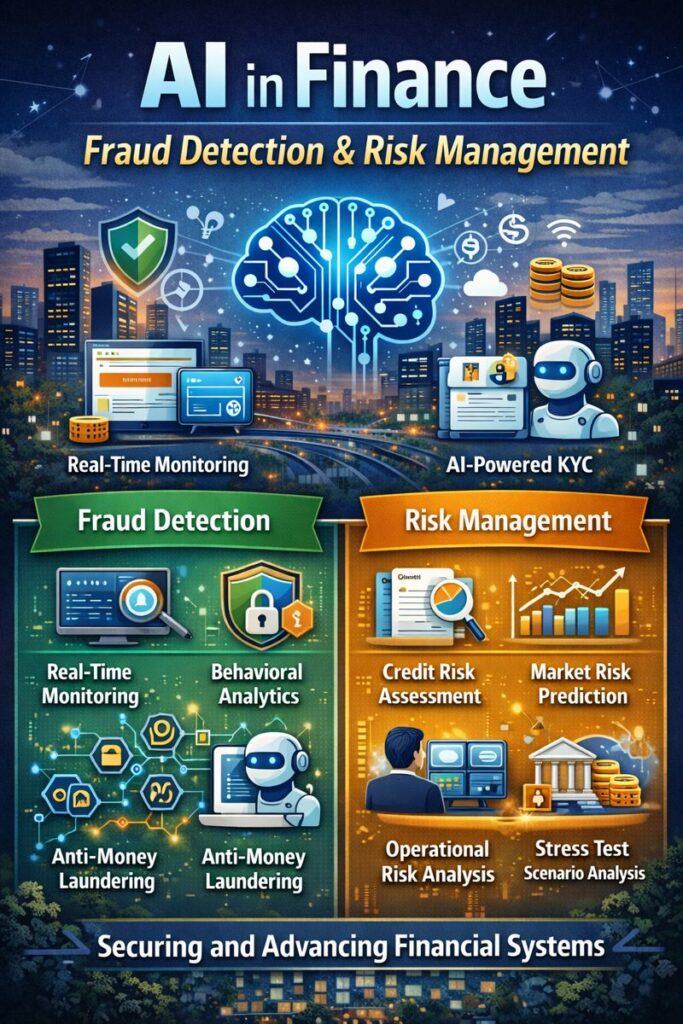
Real-Time Transaction Monitoring
AI-powered systems analyze transactions as they happen. They evaluate factors such as transaction value, location, device type, frequency, and user behavior.
If a transaction deviates from normal patterns, AI flags it instantly for review. This enables banks and payment platforms to block fraud before losses occur.
Behavioral Analytics
AI creates behavioral profiles for users based on their past activity. It learns how customers usually log in, spend money, and interact with financial platforms.
Any unusual behavior, such as a sudden high-value purchase or login from an unfamiliar location, triggers alerts. This approach reduces false positives and improves customer experience.
AI in Identity Verification and KYC
AI automates Know Your Customer (KYC) processes using facial recognition, document verification, and biometric authentication.
These systems speed up customer onboarding while preventing identity fraud. AI-based KYC also improves regulatory compliance and operational efficiency.
Anti-Money Laundering (AML) with AI
Money laundering involves complex transaction networks that are difficult to detect manually. AI identifies suspicious transaction patterns and hidden relationships between accounts.
Machine learning models prioritize high-risk alerts, allowing compliance teams to focus on serious threats. This significantly reduces manual effort and false alarms.
AI in Financial Risk Management
Risk management is critical for maintaining financial stability. AI enables institutions to move from reactive risk handling to predictive and proactive risk control.
Credit Risk Assessment
AI improves credit risk analysis by examining a wider range of data than traditional models. This includes transaction history, spending behavior, and alternative data sources.
As a result, lenders make more accurate credit decisions and expand financial inclusion for underbanked populations.
Market Risk Management
Financial markets are influenced by economic data, global events, and investor sentiment. AI analyzes historical trends, real-time market data, and news sentiment to predict market volatility.
These insights help institutions manage investment risks and optimize portfolios.
Liquidity Risk Management
AI predicts future cash flow requirements by analyzing transaction patterns and market conditions. This helps banks maintain adequate liquidity and meet regulatory standards.
Accurate liquidity forecasting also improves operational planning and financial resilience.
Operational Risk Management
Operational risks arise from system failures, human errors, and cyber threats. AI monitors system logs, employee activity, and network behavior to detect early warning signs.
Predictive analytics allows institutions to address issues before they disrupt operations.
Stress Testing and Scenario Analysis
AI simulates thousands of economic scenarios, including recessions and market crashes. These simulations help institutions assess their resilience under extreme conditions.
AI-driven stress testing improves regulatory compliance and long-term risk planning.
Benefits of AI in Fraud Detection and Risk Management
AI enables real-time fraud detection and faster risk assessment. It significantly reduces financial losses and operational costs.
Automation lowers false-positive rates and improves customer satisfaction. AI also enhances regulatory compliance and decision-making accuracy.
Overall, AI strengthens trust, security, and efficiency in financial systems.
Industry Use Cases of AI in Finance
Banks use AI for transaction monitoring, credit scoring, and AML compliance. Insurance companies rely on AI for fraud detection and risk-based pricing.
Fintech companies use AI for digital identity verification and automated lending. Cryptocurrency platforms apply AI to monitor blockchain transactions and prevent illicit activities.
Challenges and Ethical Considerations
AI systems process sensitive financial data, raising concerns about privacy and security. Strong data protection frameworks are essential.
Algorithmic bias can lead to unfair credit decisions if training data is biased. Transparency and fairness must be prioritized.
Regulators also require explainable AI models to ensure accountability and compliance.
Future of AI in Finance
The future of AI in finance includes explainable AI, autonomous risk management systems, and deeper integration with blockchain technology.
Advances in quantum computing and real-time analytics will further enhance fraud detection and financial modeling.
AI-powered financial systems will become more adaptive, secure, and customer-centric.
AI in finance is transforming fraud detection and risk management by enabling real-time monitoring, predictive analytics, and intelligent automation.
As financial systems grow more digital and complex, AI will play a critical role in protecting assets, ensuring compliance, and maintaining trust.
Responsible AI adoption, supported by strong governance and ethical frameworks, will define the future of secure and resilient financial ecosystems.