
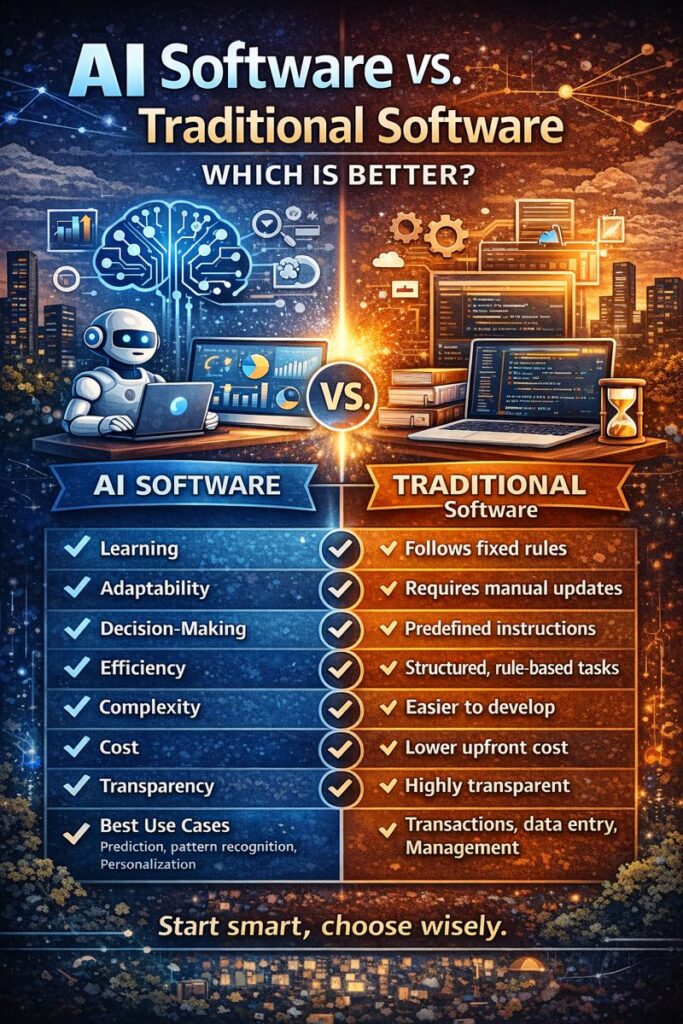
AI Software vs Traditional Software: Which Is Better?
Introduction
Software has become the backbone of modern businesses, powering everything from customer service and finance to healthcare and education. For decades, traditional software dominated the technology landscape with fixed rules and predefined logic. Today, however, AI software is transforming how applications think, learn, and adapt.
The rise of artificial intelligence has sparked an important debate: AI software vs traditional software— which is better? The answer depends on the use case, complexity, and goals of an organization.
This blog explores the key differences between AI software and traditional software, their advantages, limitations, real-world applications, and how businesses can choose the right approach.
What Is Traditional Software?
Traditional software is built using explicit rules and logic defined by programmers. It follows a clear set of instructions to perform tasks and always produces predictable outputs for given inputs.
Examples include accounting systems, basic CRM platforms, word processors, and inventory management software. These systems are highly reliable when tasks are repetitive and well-defined.
Traditional software does not learn from data. Any improvement or change requires manual updates by developers.
What Is AI Software?
AI software uses machine learning, deep learning, and natural language processing to simulate human-like intelligence. Instead of relying solely on fixed rules, AI systems learn patterns from data and improve over time.
Examples include recommendation systems, chatbots, fraud detection platforms, facial recognition systems, and predictive analytics tools.
AI software adapts to new data, handles uncertainty, and can make predictions rather than just follow instructions.
Core Difference Between AI Software and Traditional Software
The biggest difference lies in learning capability. Traditional software executes prewritten logic, while AI software learns from data.
Traditional systems require exact instructions, whereas AI systems identify patterns and make decisions even when inputs vary.
AI software handles complex and dynamic environments better, while traditional software excels in stable and predictable scenarios.
Development Approach
Traditional software development follows a structured process where requirements are clearly defined at the start. Developers write code to handle every possible scenario.
AI software development is data-centric. It involves collecting datasets, training models, testing accuracy, and continuously refining performance.
This makes AI development more iterative and experimental compared to traditional software engineering.
Flexibility and Adaptability
Traditional software is rigid by design. Any change in requirements requires code modifications and redeployment.
AI software is highly adaptable. It can adjust its behavior as new data becomes available, making it suitable for rapidly changing environments.
This adaptability gives AI software an advantage in industries such as finance, healthcare, and e-commerce.
Accuracy and Performance
Traditional software delivers consistent and deterministic results. Its accuracy depends entirely on how well the rules are written.
AI software improves accuracy over time through learning. However, it may initially produce uncertain results and requires continuous monitoring.
In tasks like pattern recognition and prediction, AI software often outperforms traditional systems.
Automation and Decision-Making
Traditional software automates predefined tasks efficiently but cannot make independent decisions.
AI software supports intelligent automation, where systems analyze data and make decisions with minimal human intervention.
This makes AI ideal for fraud detection, recommendation engines, and predictive maintenance.
Scalability
Traditional software scales by adding more servers or optimizing code.
AI software scales not only technically but also intellectually. As more data is processed, AI models become smarter and more effective.
However, AI systems often require higher computational resources and specialized hardware.
Cost Considerations
Traditional software is generally cheaper to develop and maintain. Costs are predictable and controlled.
AI software requires investment in data collection, infrastructure, model training, and skilled professionals.
While AI has higher upfront costs, it can deliver significant long-term value through efficiency and innovation.
Use Cases of Traditional Software
Traditional software works best for tasks with clear rules and minimal variability.
Examples include payroll systems, database management tools, billing software, and basic enterprise applications.
These systems are reliable, easy to test, and widely adopted across industries.
Use Cases of AI Software
AI software excels in data-intensive and complex scenarios.
Common applications include fraud detection, medical diagnosis, customer support chatbots, recommendation systems, and predictive analytics.
AI software enables businesses to gain insights and automation beyond traditional capabilities.
Security and Risk Factors
Traditional software has well-understood security risks and established mitigation strategies.
AI software introduces new challenges such as data poisoning, model bias, and explainability issues.
Proper governance, monitoring, and ethical AI practices are essential for safe AI deployment.
Ethical and Transparency Considerations
Traditional software decisions are transparent and easy to explain.
AI software, especially deep learning models, can act as black boxes. This raises concerns about accountability and fairness.
Explainable AI is becoming increasingly important to address these challenges.
Which Is Better: AI Software or Traditional Software?
There is no universal winner. Traditional software is better for structured, rule-based tasks where stability and predictability matter.
AI software is better for complex, data-driven problems that require learning, adaptation, and prediction.
Many modern systems combine both approaches, using traditional software as the backbone and AI as an intelligent layer.
Future of Software Development
The future lies in hybrid systems that integrate AI capabilities into traditional software architectures.
Low-code AI platforms and automated machine learning tools will make AI more accessible.
Organizations that adopt the right balance between AI and traditional software will gain a competitive advantage.
Conclusion
AI software and traditional software each serve distinct purposes. Traditional software offers reliability and simplicity, while AI software provides intelligence and adaptability.
Choosing the right approach depends on business needs, data availability, budget, and long-term goals.
In many cases, combining AI with traditional software delivers the best results, enabling smarter, more efficient, and future-ready systems.