
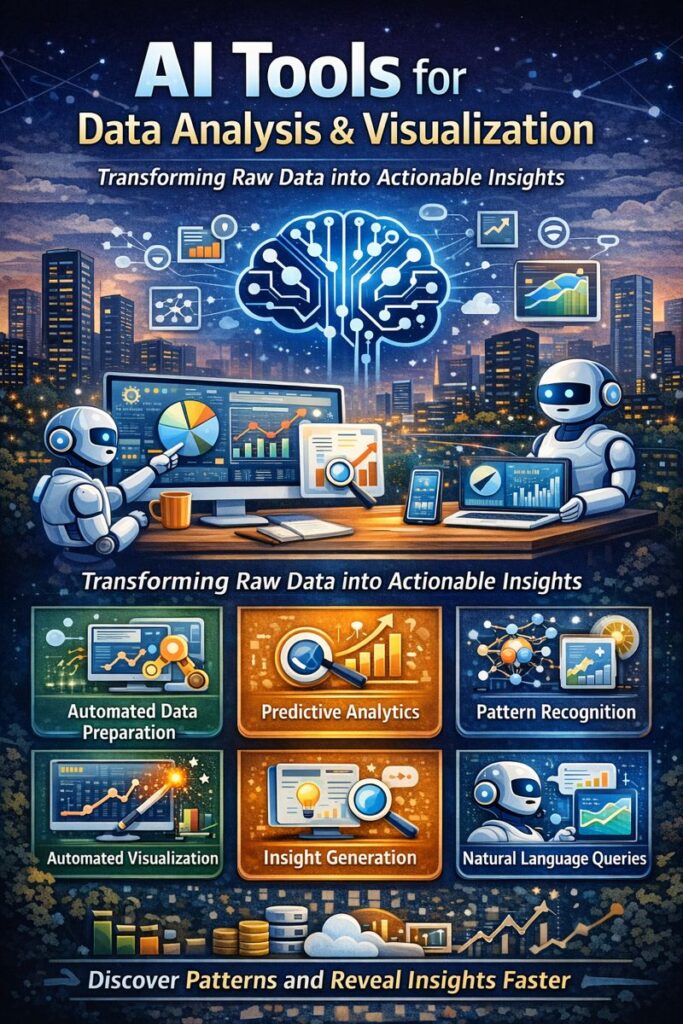
AI Tools for Data Analysis and Visualization: Transforming Insights into Intelligent Decisions
In today’s data-driven world, organizations generate massive volumes of data every second. From business transactions and social media interactions to sensor readings and web traffic, data has become one of the most valuable assets for decision-making. However, raw data alone holds little value unless it is processed, analyzed, and visualized effectively. This is where Artificial Intelligence (AI) tools for data analysis and visualization play a transformative role.
AI-powered data analysis tools help businesses uncover hidden patterns, predict trends, and make informed decisions faster than traditional methods. Meanwhile, AI-driven visualization tools convert complex datasets into intuitive visuals that enhance understanding and communication. Together, they bridge the gap between data and actionable intelligence.
This blog explores how AI tools are reshaping data analysis and visualization, their key features, benefits, popular tools, real-world applications, challenges, and future trends.
Understanding AI in Data Analysis
AI in data analysis refers to the use of machine learning algorithms, deep learning models, and natural language processing techniques to automatically analyze data, detect patterns, and generate insights. Unlike traditional analytics, AI systems learn from data and continuously improve their performance over time.
These tools can process structured and unstructured data at scale. They reduce human intervention and eliminate many manual steps involved in data cleaning, exploration, and modeling. As a result, analysts and decision-makers can focus more on interpreting results rather than preparing data.
AI-powered analytics is especially valuable in environments where data is complex, dynamic, and rapidly growing. It enables real-time analysis, predictive modeling, and automated reporting, making it indispensable for modern enterprises.
Role of AI in Data Visualization
Data visualization transforms numbers into charts, graphs, dashboards, and interactive visuals. AI enhances this process by automating design choices, suggesting the best visualization types, and generating insights directly from visual data.
AI-driven visualization tools analyze datasets and automatically highlight anomalies, correlations, and trends. They can also adapt visuals based on user behavior, ensuring that stakeholders receive the most relevant information.
Natural language interfaces further simplify visualization. Users can ask questions in plain English, and AI tools generate appropriate charts instantly. This democratizes data access and empowers non-technical users to explore data independently.
Key Features of AI-Powered Data Analysis Tools
One of the most significant features of AI-based data analysis tools is automated data preparation. These tools clean, normalize, and preprocess data without extensive manual effort. They handle missing values, outliers, and inconsistencies efficiently.
Another important feature is predictive analytics. AI models forecast future outcomes based on historical data. Businesses use these predictions to plan strategies, manage risks, and optimize resources.
AI tools also provide pattern recognition and anomaly detection. They identify unusual behavior or deviations that may indicate fraud, system failures, or emerging trends.
Additionally, natural language processing enables conversational analytics. Users can query data using natural language, making analysis more accessible to a wider audience.
Key Features of AI-Powered Visualization Tools
AI-powered visualization tools automatically recommend the most suitable charts and layouts based on data characteristics. This eliminates guesswork and improves clarity.
Another feature is real-time interactive dashboards. These dashboards update dynamically as new data arrives, providing up-to-date insights.
AI visualization tools also include insight narration, where the system explains trends and anomalies in simple language. This helps stakeholders quickly understand key takeaways.
Personalization is another advantage. AI adapts dashboards according to user roles and preferences, ensuring relevant insights for executives, analysts, and operational teams.
Popular AI Tools for Data Analysis
Several AI-powered tools dominate the data analytics landscape today.
Python-based AI libraries such as Pandas, NumPy, Scikit-learn, and TensorFlow are widely used for data analysis and machine learning. They offer flexibility and extensive community support.
AutoML platforms like H2O.ai and Google AutoML automate model selection, training, and evaluation. These tools reduce the need for deep machine learning expertise.
Enterprise analytics platforms such as IBM Watson Analytics and SAS Analytics use AI to deliver predictive insights, automated reporting, and advanced statistical modeling.
These tools cater to both beginners and advanced users, making AI-driven analytics more accessible.
Popular AI Tools for Data Visualization
AI-powered visualization tools are designed to simplify storytelling with data.
Tableau uses AI features like “Explain Data” to automatically identify factors influencing trends. It also supports natural language queries for instant visualization.
Power BI integrates AI-driven analytics and visualization, allowing users to create intelligent dashboards with minimal effort.
Google Looker Studio leverages AI to generate interactive reports and insights, especially for marketing and web analytics.
Qlik Sense employs associative AI to explore relationships in data and provide automated insights through interactive visuals.
These tools help organizations transform complex datasets into meaningful stories.
Benefits of Using AI Tools for Data Analysis and Visualization
One of the biggest benefits is speed and efficiency. AI tools process massive datasets quickly, delivering insights in real time.
Another advantage is accuracy and consistency. AI models reduce human error and ensure standardized analysis across datasets.
AI tools also improve decision-making by uncovering patterns that might be missed by traditional analysis. This leads to better strategic planning and operational optimization.
Cost reduction is another key benefit. Automation reduces the need for manual labor and speeds up workflows, saving time and resources.
Finally, AI tools enhance data democratization, enabling non-technical users to interact with data confidently.
Applications of AI in Data Analysis and Visualization
AI tools are widely used across industries.
In business intelligence, AI-driven dashboards help executives track performance, monitor KPIs, and forecast revenue.
In finance, AI analyzes transaction data to detect fraud and assess risk. Visualization tools present these insights clearly to compliance teams.
In healthcare, AI analyzes patient data to predict outcomes and visualize trends in treatment effectiveness.
In marketing, AI tools analyze customer behavior and visualize campaign performance, enabling data-driven strategies.
In education, AI analytics track student performance and visualize learning patterns to improve outcomes.
AI and Big Data Analytics
Big data environments involve massive volumes of data with high velocity and variety. Traditional tools struggle to handle such complexity.
AI-powered analytics excels in big data scenarios by processing large datasets efficiently and extracting meaningful insights. Visualization tools further simplify the interpretation of big data by presenting summaries, trends, and correlations visually.
Together, AI and big data analytics empower organizations to turn vast datasets into strategic assets.
Challenges in Using AI Tools for Data Analysis
Despite their benefits, AI tools face certain challenges.
Data quality remains a major concern. AI models are only as good as the data they analyze. Poor-quality data can lead to misleading insights.
Another challenge is interpretability. Some AI models act as black boxes, making it difficult to understand how decisions are made.
Data privacy and security are also critical issues, especially when handling sensitive information.
Additionally, organizations may face skill gaps and resistance to adopting AI-driven solutions.
Ethical Considerations in AI-Driven Analytics
Ethics plays a crucial role in AI-powered data analysis.
Bias in data can lead to biased outcomes. AI tools must be designed to ensure fairness and transparency.
Responsible data usage and compliance with regulations such as data protection laws are essential.
Explainable AI techniques are increasingly important to build trust and accountability in AI-driven decisions.
Future Trends in AI Data Analysis and Visualization
The future of AI in data analysis and visualization is promising.
Explainable AI will gain more importance, making AI-driven insights more transparent and trustworthy.
Augmented analytics will become mainstream, combining AI automation with human expertise.
Real-time analytics and visualization will expand further with the growth of IoT and streaming data.
AI-powered storytelling will evolve, enabling systems to automatically generate narratives alongside visuals.
These trends will further enhance the value of AI tools in data-driven decision-making.
AI tools for data analysis and visualization are transforming how organizations understand and use data. By automating complex processes, uncovering hidden patterns, and presenting insights visually, these tools empower faster and smarter decision-making.
As data continues to grow in volume and complexity, AI-driven analytics and visualization will become essential for businesses, researchers, and institutions. Organizations that adopt these tools strategically will gain a significant competitive advantage in the digital era.
Harnessing AI for data analysis and visualization is no longer a luxury—it is a necessity for success in a data-centric world.